Energy Companies Are Under Increasing Cyber Pressure
Energy companies have always been attractive targets for cyber criminals, but the scale, sophistication and frequency of attacks have increased dramatically over the past decade.
The energy sector sits at the centre of modern society. Electricity generation, gas distribution, renewable energy farms, battery storage facilities, EV charging networks and smart grids all depend on connected digital systems. That connectivity creates efficiency, but it also creates opportunities for attackers.
Recent years have seen a sharp increase in ransomware attacks, supply-chain compromises, espionage campaigns and attempts to access operational technology (OT) systems that control physical infrastructure.
This growing threat landscape is one reason why organisations are increasingly discussing topics such as What Are the Emerging Cyber Threats Facing UK Energy Infrastructure?
Why Energy Companies Have Become Prime Targets
Critical Infrastructure Has Strategic Value
Unlike many industries, energy companies provide services that entire nations depend upon.
Disrupting electricity supplies, gas networks or fuel distribution can have immediate economic and social consequences.
Hospitals, transport systems, communications networks, financial institutions and emergency services all rely on continuous power.
This makes energy infrastructure highly attractive to:
- Cyber criminals seeking ransom payments
- Nation-state actors conducting espionage
- Hacktivist groups pursuing political objectives
- Terrorist organisations seeking disruption
- Opportunistic attackers exploiting vulnerabilities

- 【OBSBOT × EWC 2025 Official Partnership】OBSBOT is thrilled to be the 2025 Esports World Cup (EWC) Official Camera & Webc…
- 【OBSBOT Tiny 2 – New Era of Webcam】Our 4K Webcam is equipped with 1/1.5″ CMOS Sensor, which is the largest and most adva…
- 【Superior AI-Tracking, Up 4 Tracking Modes】Our Tracking Webcam has fully upgraded the AI algorithm to make the auto-trac…
Digital Transformation Has Increased Attack Surfaces
The UK’s energy sector has undergone rapid digital transformation.
Modern energy systems increasingly rely upon:
- Smart meters
- Internet-connected sensors
- Cloud platforms
- Remote monitoring systems
- Renewable energy control networks
- EV charging infrastructure
- AI-powered operational tools
While these technologies improve efficiency, they also create additional entry points for attackers.
The Rise of Nation-State Cyber Activity

Geopolitical Tensions Are Driving Attacks
Global geopolitical instability has increased cyber activity against critical infrastructure worldwide.
Energy companies are particularly exposed because energy supplies often play a central role in international politics and national security.
Security agencies across Europe and North America have repeatedly warned that hostile states continue to target critical infrastructure operators for intelligence gathering and potential disruption activities.
The UK’s energy sector remains a high-value target due to its strategic importance and advanced digital infrastructure.
This is closely linked to concerns explored in How Could Geopolitical Tensions Affect UK Energy Cyber Security?
Attackers Often Remain Hidden
Many sophisticated cyber operations are designed to remain undetected.
Rather than causing immediate disruption, attackers may seek to:
- Map networks
- Identify vulnerabilities
- Gather intelligence
- Establish persistent access
- Position themselves for future operations
As a result, some organisations may have experienced compromise attempts without ever realising it.
Ransomware Attacks Continue to Grow
Financially Motivated Criminals Are Becoming More Aggressive
Ransomware remains one of the biggest cyber threats facing energy companies.
Modern ransomware groups operate like businesses.
They employ:
- Developers
- Negotiators
- Data analysts
- Access brokers
- Customer support teams
An unusual business model, admittedly. Criminal enterprises now offering better customer service than some legitimate organisations.
Energy firms are attractive targets because downtime can be extremely costly.
Attackers know that prolonged outages can pressure organisations into paying significant ransoms.

- Back-UPS BX provides guaranteed power and surge protection for desktop computers, wireless networks, gaming consoles and…
- 700 VA/390 Watts – Automatic Voltage Regulation (AVR)
- PowerShute shutdown software – USB Connector
Double and Triple Extortion Tactics
Modern attacks rarely focus solely on encrypting systems.
Criminal groups increasingly:
- Steal sensitive data
- Threaten public disclosure
- Contact customers directly
- Target suppliers and partners
- Launch denial-of-service attacks
This significantly increases pressure on victims.
Operational Technology Is Under Greater Threat
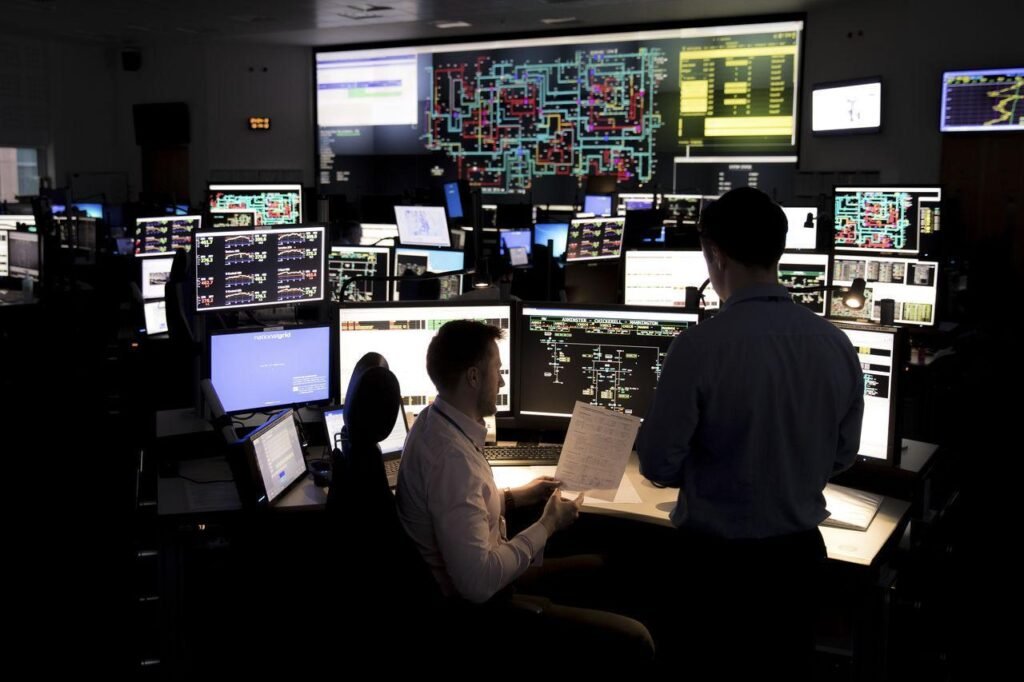
OT Systems Control Physical Assets
Traditional IT systems handle business functions such as emails and finance.
Operational Technology systems control physical processes including:
- Power generation
- Grid management
- Pipeline operations
- Renewable energy facilities
- Battery storage sites
- Industrial control systems
Attacks against OT environments can potentially create real-world consequences.
Convergence of IT and OT Creates New Risks
Historically, operational systems were isolated.
Today many OT environments connect to wider corporate networks for monitoring, automation and efficiency.
This convergence improves operations but also creates potential pathways for attackers moving from business systems into operational environments.
Renewable Energy Infrastructure Is Expanding the Threat Landscape

New Technologies Bring New Vulnerabilities
The UK’s transition towards renewable energy has introduced thousands of additional connected assets.
These include:
- Offshore wind farms
- Solar installations
- Smart substations
- Energy storage systems
- Distributed generation facilities
Every connected device potentially becomes part of the attack surface.
This issue is explored further in What Does the Future of Energy Cyber Security Look Like?
Supply Chains Are Becoming More Complex
Energy companies increasingly rely on:
- Third-party software vendors
- Cloud providers
- Equipment manufacturers
- Managed service providers
- Remote maintenance contractors
Attackers often target suppliers as a route into larger organisations.
Several major cyber incidents globally have originated through trusted third-party relationships.
Are Attacks Actually Increasing?
The Evidence Suggests Yes
Most cybersecurity professionals working within critical infrastructure agree that threat activity has increased substantially.
Several factors contribute to this assessment:
- More attack attempts detected
- Greater sophistication of tools
- Increased automation by criminals
- Growth of ransomware ecosystems
- Expansion of connected infrastructure
- Rising geopolitical tensions
The result is a threat environment that is both broader and more complex than it was ten years ago.
Better Detection Also Reveals More Threats
Part of the increase may reflect improved visibility.
Modern monitoring tools identify threats that would previously have gone unnoticed.
However, most experts believe the increase is genuine rather than merely a consequence of improved detection.
How Are UK Energy Companies Responding?
Investment in Cyber Security Is Rising
Many UK energy operators have significantly increased cybersecurity spending.
Key areas include:
- Security Operations Centres (SOCs)
- Threat intelligence
- Incident response planning
- OT security monitoring
- Network segmentation
- Staff awareness training
- Vulnerability management
Regulatory Requirements Are Strengthening
Energy organisations face increasing regulatory scrutiny.
Requirements now focus on:
- Risk management
- Incident reporting
- Supply chain security
- Operational resilience
- Business continuity
National bodies such as the National Cyber Security Centre and Ofgem continue to work with industry to improve resilience across the sector.
Could Cyber Attacks Cause Major Disruption?
The Risk Is Real
A successful cyber attack against critical energy infrastructure could potentially affect:
- Electricity supplies
- Fuel distribution
- Industrial operations
- Transport systems
- Communications networks
However, most energy companies operate multiple layers of technical and operational safeguards designed to reduce this risk.

- [Fastest Charging in the Industry] – Fully recharge using an AC outlet in only 70 minutes with EcoFlow’s X-Stream fast c…
- [Power 80% of Your Appliances] – With an output of up to 1600W, run 80% off all your appliances, even high wattage ones….
- [LFP Long-Life Battery] – Using LFP battery cells, use and recharge RIVER 2 Pro more than 3000 times before hitting 80%….
Resilience Remains a Priority
The UK energy sector has invested heavily in resilience planning.
Operators regularly conduct:
- Cyber exercises
- Recovery testing
- Incident simulations
- Business continuity planning
- Threat intelligence sharing
These activities help reduce the likelihood of severe disruption.
Readers interested in the wider implications should also explore Could a Cyber Attack Cause UK Blackouts? and How Prepared Is the UK for Cyber Attacks on Critical Infrastructure?
Final Thoughts
Energy companies are facing more cyber threats than ever before.
The combination of digital transformation, renewable energy expansion, geopolitical tensions, ransomware growth and increasingly connected infrastructure has created one of the most challenging threat environments the sector has ever experienced.
The good news is that awareness, investment and defensive capabilities have also improved significantly. Energy operators understand the risks and continue to strengthen their defences.
The challenge is that attackers are evolving just as quickly.
Cybersecurity in the energy sector is no longer simply an IT issue. It is a national resilience issue, an economic issue and increasingly a matter of national security.
For UK energy companies, the question is no longer whether cyber threats exist. The question is how quickly organisations can adapt to a threat landscape that changes almost daily. Humans invented smart grids, AI-powered infrastructure and remotely managed energy networks, then seemed surprised that attackers also noticed. Such is the eternal cycle of technology.